News Story
UMD-Developed AI Tool Advances Building Decarbonization and Compliance

UMD's custom-developed Rapid Energy Auditor software harnesses AI and machine learning for fast, reliable virtual energy audits. The software identifies which buildings would benefit most from an intensive follow-up hands-on audit that includes interviews with facility managers.
The clock is ticking for building owners in Maryland. Beginning in 2030, buildings larger than 35,000 square feet must meet state carbon-emissions targets or face financial penalties. Help is on the way. Harnessing machine learning, the UMD Center for Environmental Energy Engineering (CEEE) has upgraded its custom-developed energy-auditing software to help building owners in Maryland and beyond predict energy use and emissions.
Developed by CEEE’s Smart and Small Thermal Systems (S2TS) laboratory, in conjunction with the State of Maryland Department of General Services, the Rapid Energy Auditor (REA) software identifies areas for improvement, quickly pinpoints which buildings could benefit most from energy efficiency and decarbonization measures, and forecasts energy usage and emissions using its AI and ML algorithms that have and continue to be used on large clusters of commercial buildings.
The building sector accounts for over 40% of energy consumption and 75% of electricity consumption in the United States. Given that scale, the UMD-developed Rapid Energy Auditor software could offer a powerful tool for combating climate change and reducing energy costs.
“REA provides a transformative solution for conducting virtual energy audits and planning decarbonization strategies for large building portfolios,” says CEEE Co-Founder and Minta Martin Professor Michael Ohadi, who spearheads REA development.
Going virtual
Since 2018, S2TS has conducted on-site energy audits across more than 10 million square feet of state-owned facilities in Maryland. In partnership with the Maryland Department of General Services’ Office of Energy and Sustainability, the S2TS team evaluates each building to identify energy efficiency opportunities and decarbonization strategies. To date, this work has revealed over $72 million in potential savings and an estimated 11% reduction in annual energy consumption — if all recommended measures are implemented.
“Clearly, traditional on-site audits play an important role in compliance and decarbonization in certain circumstances,” Ohadi says, “but ML and AI-driven tools are replacing traditional time-consuming and resource-intensive methods, and their accuracy is continuously increasing.”
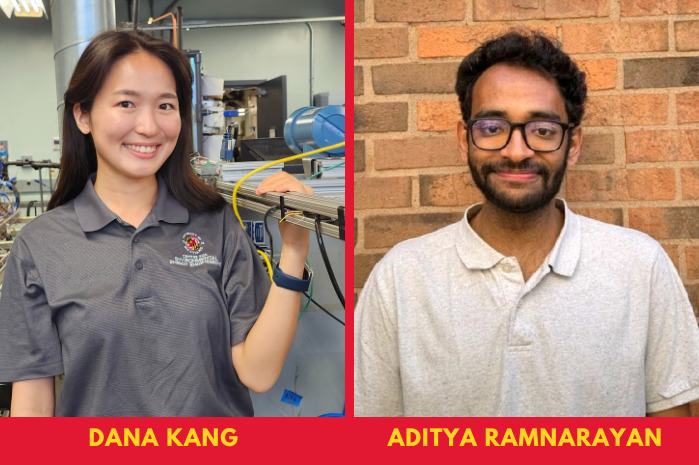
Ph.D. candidate Aditya Ramnarayan, who started his graduate studies in 2021, recalls a two-hour car ride to Salisbury, Maryland, for an on-site energy audit, when he first joined the audit team — only to find a facility with little room for improvement. “That wasn’t the best use of our resources,” he says. There had to be a more efficient approach.
The custom-developed Rapid Energy Auditor uses AI and machine learning algorithms to quickly assess the energy efficiency of large clusters of commercial buildings and forecast their energy usage.
In 2022, the S2TS team began developing the REA software tool, Rapid Energy Auditor, to provide a preliminary audit in minutes rather than weeks. The software taps into utilities data to create a quick snapshot of energy performance. The goal isn’t to eliminate all in-person audits, but rather to provide immediate feedback and flag facilities that could benefit from a follow-up onsite assessment. Over time, the team developed a multi-criteria ranking algorithm to rate building performance based on three factors: energy-use intensity, carbon emissions per square foot and dollar-saving potential per square foot.
“The idea was to combine these three metrics to rank the facilities from the worst-performing to the best-performing ones. Then we know where to prioritize our attention and where to target, so that we can get the most savings,” says Ramnarayan, who presented a paper on the multi-criteria ranking approach at the 2025 annual conference of the American Society of Heating, Refrigerating and Air-Conditioning Engineers.
The REA approach enables the team to evaluate significantly more facilities each year, increasing the opportunity for cost savings. To date, the team has conducted virtual audits covering 40 million square feet of state facilities, including 10 million square feet assessed in person. These efforts have identified measures that could deliver an estimated $25.6 million in annual energy savings if fully implemented.
Enter artificial intelligence
The state of Maryland has enacted one of the most ambitious climate plans in the country. The Climate Solutions Now Act of 2022 requires buildings larger than 35,000 square feet to achieve net-zero greenhouse gas (GHG) emissions by 2040 or pay a fee. Starting in 2030, buildings must meet interim targets or face penalties.
To avoid these fees, building owners need accurate projections — which is where AI comes in. The latest version of REA uses an AI-driven analytical engine to predict energy usage and carbon emissions, and even determines related penalties. “Through machine learning, we leverage historical data along with ambient weather data, building characteristics and equipment age to predict building performance,” says Ramnarayan. “REA also calculates the cost of inaction, the fee building owners will pay if they don’t make any upgrades,” he explains. “What are the monetary repercussions? Because we all know that if you don't do anything, your building will perform worse with age.
“We provide the analytics. Then, the choice is in the hands of building owners. Do you want to pay for upgrades, or pay the penalties? At the end of the day, everything comes down to numbers,” Ramnarayan says.
In a study published last year in Energies, the S2TS team used machine learning to forecast energy consumption and GHG emissions on a portfolio of over 100 buildings. “The study demonstrated that robust machine learning models can generate accurate forecasts to evaluate carbon compliance and guide prompt action in decarbonizing the built environment,” says Ramnarayan, the paper’s lead author.
The predictive feature currently supports operations across 45 million square feet of state-owned buildings in Maryland and can be customized for any facility using its historical energy data and building-specific information. REA has already proven to be an effective tool for the State of Maryland, advancing its ambition to rank among the nation’s leading states in emissions reduction and energy cost efficiency.
“Beyond its impact within Maryland, REA has the potential to become a Maryland-born global energy optimization platform, serving facilities worldwide and benefiting millions,” Ohadi says.
Published March 13, 2026
Related Stories
Stories / October 21, 2026
TEDx Talk Spotlights UMD’s Work to Improve Energy Efficiency...

Stories / March 18, 2026
AI-Powered Hybrid Model Could Boost HVAC Efficiency

Stories / July 24, 2025
UMD Study Compares AI Models for HVAC Systems, Highlighting...
Stories / October 19, 2026
UMD Team Develops More Efficient Heat Pump for Wood Drying

Stories / August 19, 2026
UMD Develops ML Tool to Predict Uneven Airflow in AC Systems

Stories / August 11, 2026
Terp Travel: Students Collaborate on Sustainable Energy...

Stories / May 18, 2026
Dissertation Introduces AI-Powered Hybrid Model for HVAC Systems

Stories / February 13, 2026
Heat Pump Innovation Wins Third Place in Pitch Competition

Stories / November 7, 2025
CEEE Welcomes Assistant Research Scientist Sunil Kumar

Stories / June 3, 2025
Graduate Students Awarded Scholarships for HVAC&R Research