News Story
UMD Team Advances Method to Boost Compressor Efficiency

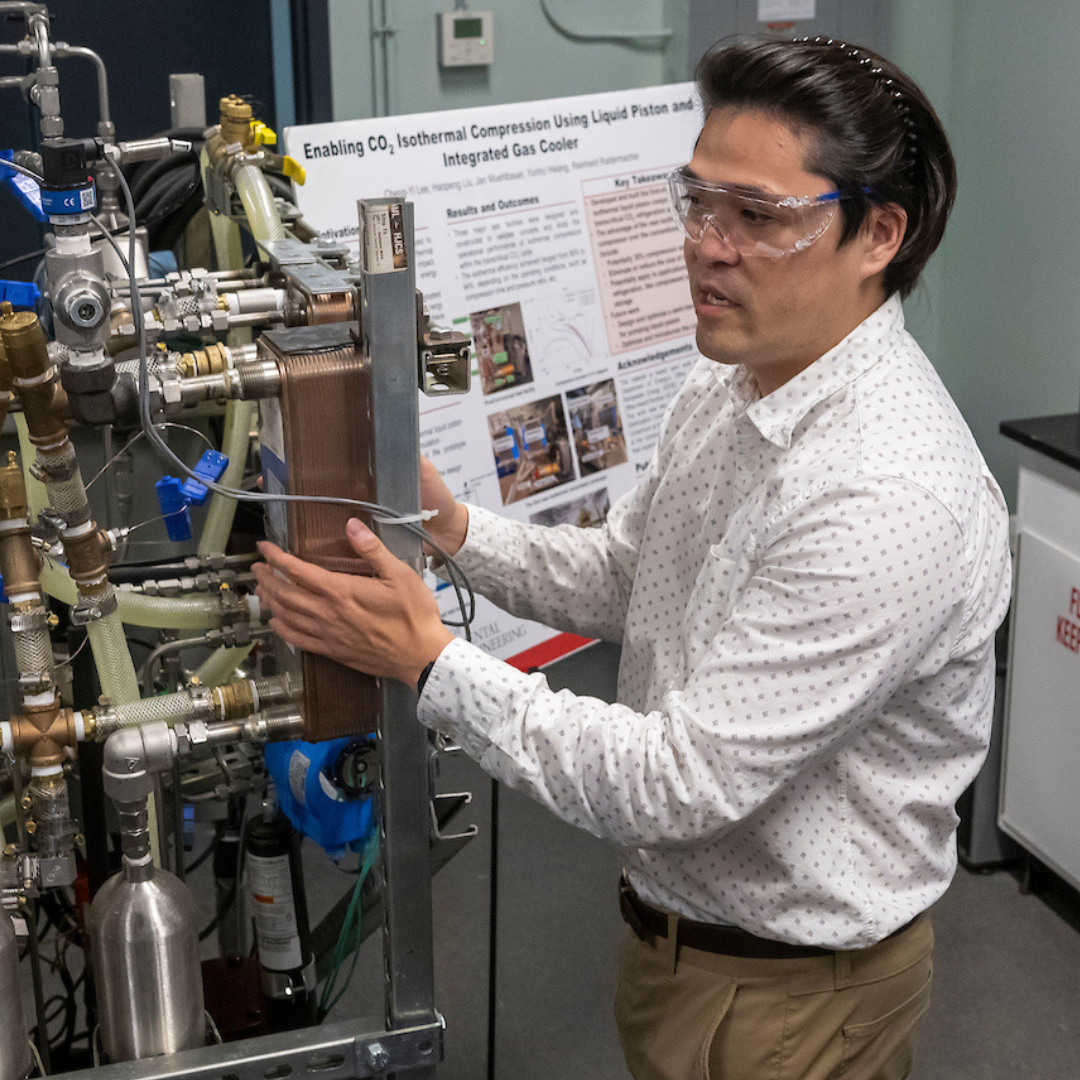
CEEE postdoctoral researcher Haopeng Liu with the center’s near-isothermal compressor prototype, which could offer more efficient compression and reduce power consumption.
A research team at the UMD Center for Environmental Energy Engineering (CEEE) is developing a new approach to improve compressor efficiency in cooling and refrigeration systems. In their latest work, the CEEE researchers created a dynamic model that identifies a design strategy to further improve performance. The findings were published in the journal Applied Thermal Engineering.
The compressor is the core component of vapor-compression air-conditioning and refrigeration systems and accounts for the largest share of energy use. “Traditional compressor technology has been investigated extensively; however, research gaps remain, particularly in improving energy efficiency,” says lead author Haopeng Liu, a CEEE postdoctoral researcher in the Department of Mechanical Engineering. “We are trying a very different approach to improve compressor efficiency.”
Unlike traditional vapor compression systems, in which the compressor and heat exchanger are two separate components, the proposed technology combines them into a single unit. In this design, a liquid piston compresses the working fluid while an integrated heat exchanger simultaneously removes heat. This strategy keeps the temperature of the working fluid nearly constant — a process known as near-isothermal compression. Because this type of compression requires less work than conventional isentropic compression, it can significantly improve efficiency.
“This technology has the potential to offer more energy-efficient cooling and refrigeration,” says Liu, “with potential applications ranging from supermarket refrigeration to data center cooling.”
"This technology has the potential to offer more energy-efficient cooling and refrigeration, with potential applications ranging from supermarket refrigeration to data center cooling.”
Postdoctoral researcher Haopeng Liu
In this study, the CEEE researchers developed a transient model to represent the system and to explore strategies to enhance heat transfer during the compression cycle. Co-authors are former CEEE postdoctoral researcher Cheng-Yi Lee, Senior Faculty Specialist Jan Muehlbauer, Research Professor Yunho Hwang and CEEE Director and Research Professor Vikrant Aute.
The researchers compared two design approaches: a “continuous geometry design,” which directly modifies the compression chamber shape, and a “discrete geometry design,” which reconfigures the interconnection layout among modular chambers while maintaining the original chamber shape. Simulation results indicate that the discrete geometry design can improve energy efficiency relative to the current prototype, providing guidance for the development of the next-generation prototype.
Future research will investigate other liquid piston media with low solubility and low viscosity to further reduce pump energy consumption and improve overall system efficiency.
Download the paper: “Dynamic modeling of near isothermal compressor for transcritical carbon dioxide cycle to support efficiency improvement.”
Published June 1, 2026
Related Stories
Stories / October 27, 2025
CEEE Postdoctoral Researcher Cheng-Yi Lee Heads On to Industry...
Stories / December 9, 2024
CEEE Team Innovates Efficient HVAC&R Compressor Technology
Stories / July 31, 2026
CEEE Director Vikrant Aute Receives Distinguished Service Award

Stories / March 18, 2026
AI-Powered Hybrid Model Could Boost HVAC Efficiency

Stories / February 2, 2026
Study Investigates How to Optimize PCM-Integrated HVAC Systems

Stories / July 17, 2025
State of Affairs: UMD Team Assesses Energy Efficiency of...
Stories / June 3, 2025
Graduate Students Awarded Scholarships for HVAC&R Research
Stories / March 27, 2025
CEEE Interns Present Analysis of Energy-Saving Opportunities at...
Stories / January 13, 2025
From Turmoil to Triumph: A CEEE Staffer’s Journey
Stories / November 5, 2024
CEEE Study Explores How AI Can Reduce HVAC Energy Consumption