News Story
Terp Travel: Students Collaborate on Sustainable Energy Solutions With International Peers

As a mechanical engineering undergraduate at the University of Maryland, Yara Daher ’25, always dreamed of studying abroad. This summer, as a master’s student, she finally found the opportunity she had been waiting for: the International Joint Graduate Course in Sustainable Energy Conversion and the Environment in Hamburg, Germany.
The two-week course in July brought together graduate students from five universities around the world, including the University of Maryland, to explore solutions to global energy challenges. The other participating universities are Korea University (South Korea), Shanghai Jiao Tong University (China), Waseda University (Japan), and this year’s host, Hamburg University of Technology (Germany).
“This class excited me because it gave me the opportunity to meet students from several different countries and universities,” says Daher, a graduate research assistant with the UMD Center for Environmental Energy Engineering, who is working toward an M.S. in mechanical engineering. “I enjoyed getting to know them and comparing our experiences as grad students in similar fields.” Daher was one of two UMD engineering graduate researchers participating in this summer’s program.
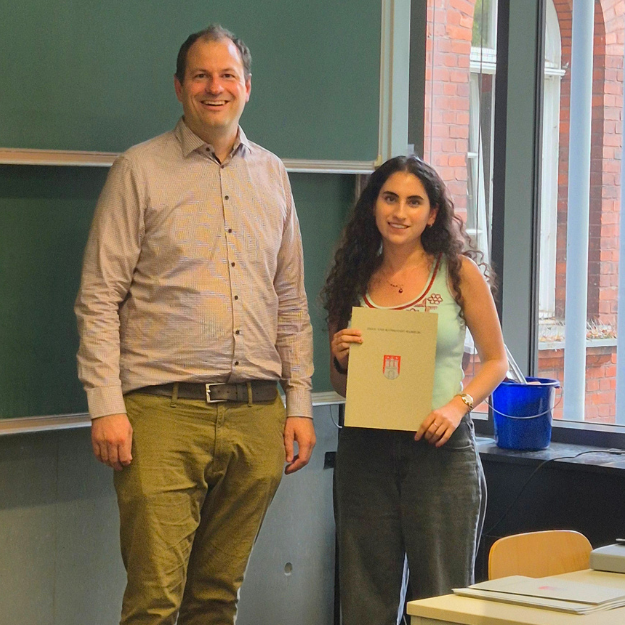
Yara Daher proudly displays her certificate of completion, presented to her by Hamburg University of Technology Professor Arne Speerforck.
The seminar’s 25 international students attended daily lectures taught by professors from the participating universities, each offering a unique perspective. Lectures focused on pressing topics, such as global warming, nuclear energy and data center cooling.
Instructors included UMD Research Professor Yunho Hwang, director of CEEE’s Consortium for Energy Efficiency and Heat Pumps. Hwang’s 36-hour journey to Hamburg included weather delays, missed connecting flights, and rerouting to a three-transfer train ride and an overnight bus trip. Despite the challenges, he was determined to arrive in time to teach the course.
“This international course is designed for graduate students to learn about our past and current efforts to reduce carbon emissions in our critical mission of providing thermal and food safety,” says Hwang, an expert on refrigeration and air-conditioning systems. “The ultimate goal is to prepare the next generation of researchers to tackle the global issue of carbon emissions and explore the potential solutions.”
“The ultimate goal is to prepare the next generation of researchers to tackle the global issue of carbon emissions and explore the potential solutions.”
Research Professor Yunho Hwang
His lectures stressed the importance of energy efficiency in air-conditioning systems and taught students how to evaluate the global warming impact of an HVAC system over its full life cycle.
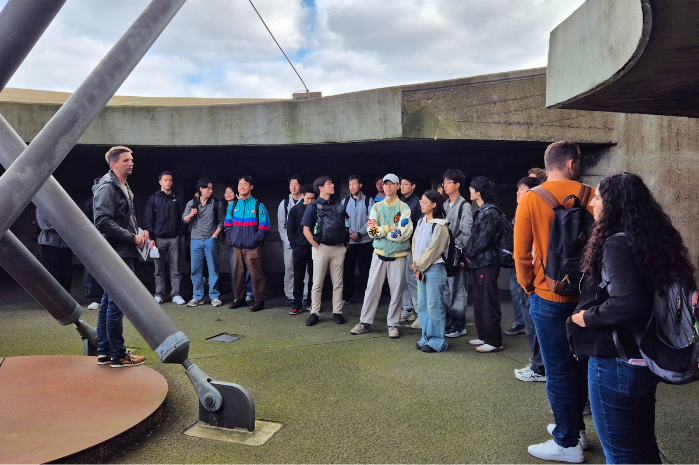
Participants toured Hamburg's Energy Bunker, a World War II air raid bunker that's been transformed into a climate-friendly energy plant.
Each afternoon, the students gathered in small international teams to work on group assignments. They collaborated in English, with translation apps coming to the rescue when team members occasionally struggled to communicate complex concepts.
During their free time, participants bonded over traditional German-style barbecues, complete with bratwurst, potato salad and other local favorites, and enjoyed off-campus excursions. A highlight included a technical tour of Hamburg’s Energy Bunker — a former World War II air-raid bunker converted into a renewable energy plant that supplies electricity and heat to the surrounding community.
For their final project, each team developed a climate neutrality plan for one of the five participating countries, outlining strategies to achieve net-zero emissions by 2040. On the final day, the teams presented their plans, sparking rich conversations on the energy challenges ahead. Thanks to the first-hand insights of international faculty and students, participants gained a deeper understanding of each country’s research efforts, policies and regulation, and market development.
“It was interesting to see the different approaches to problems,” says Daher, whose research at UMD focuses on steady-state modeling of vapor compression systems. “Not only did the participants come from different cultures, but they had different technical backgrounds. I got to meet students working on fuel cells and hydrogen technologies and other students who are researching renewable energy.”
That broader perspective will help make her a more well-rounded engineer when she graduates next May and begins her career in industry.
The 2027 International Joint Seminar in Sustainable Energy Conversion and the Environment will be held at Korea University in Seoul, South Korea.
Published August 11, 2026
Related Stories
Stories / March 13, 2026
UMD-Developed AI Tool Advances Building Decarbonization and...

Stories / February 13, 2026
Heat Pump Innovation Wins Third Place in Pitch Competition

Stories / June 3, 2025
Graduate Students Awarded Scholarships for HVAC&R Research
Stories / October 22, 2024
How Much Wood Could a Heat Pump Dry?
Stories / Sep 22, 2026
Two Years Running, Maryland #12 Among Publics for Undergrad...

Stories / Sep 4, 2026
Md Nasim Mia Receives Graduate Endowed Fellowship

Stories / Aug 26, 2026
Graham Named Honorary ASME Member

Stories / Aug 24, 2026
UMD Hosts Teachers for a Summer of Sustainable Cooling Research

Stories / Aug 19, 2026
UMD Develops ML Tool to Predict Uneven Airflow in AC Systems

Stories / Aug 11, 2026
Terp Travel: Students Collaborate on Sustainable Energy...

Stories / Jul 31, 2026
CEEE Director Vikrant Aute Receives Distinguished Service Award

Stories / Jul 27, 2026
Dissertation Advances Elastocaloric Cooling Toward...

Stories / Jul 24, 2026
Dissertation Introduces Advanced Modeling Methods to Improve...

Stories / Jun 25, 2026
UMD Design Could Boost Cold-Climate Heat Pump Performance
