News Story
Dissertation Advances Elastocaloric Cooling Toward Commercialization

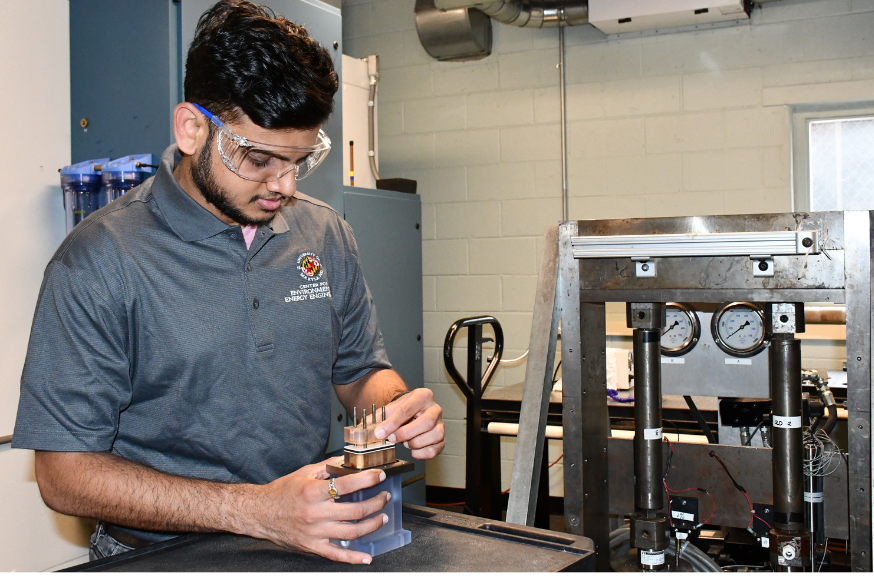
Het Mevada assembles a cascade elastocaloric cooling prototype in CEEE's Daikin Energy Innovation Laboratory. In the background is an earlier prototype.
Congratulations to Het Mevada on defending his Ph.D. dissertation, “Performance Enhancement of Elastocaloric Cooling Through System Optimization, Novel Material Architectures, and Scalable Design.” Mevada is concluding his work as a graduate research assistant with the Center for Environmental Energy Engineering (CEEE) and will be receiving his doctoral degree in mechanical engineering.
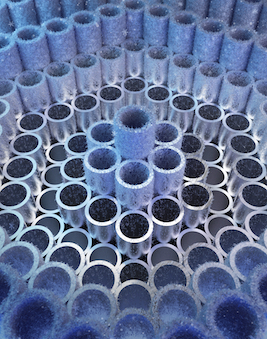
Mevada’s research focused on elastocaloric cooling, a promising alternative to conventional vapor-compression systems. Instead of using greenhouse gas refrigerants, elastocaloric systems rely on metals, giving the technology zero global warming potential. Elastocaloric cooling leverages a group of metals called shape memory alloys (SMAs), which release heat when compressed and absorb heat when relaxed, causing the temperature around them to drop.
For his dissertation, Mevada advanced elastocaloric cooling and helped bring the technology closer to commercialization. His research identified a major performance challenge: SMAs do not always stretch evenly, and this strain maldistribution can reduce cooling performance.
To address this issue, the research team combined two complementary approaches: multi-stage SMA tubes, in which different sections activate at slightly different temperatures, and functionally graded materials, in which material properties gradually change along the length. Together, these architectures achieved a minimum 66% reduction in strain maldistribution and extended the operational temperature range from 15–35°C to 0–70°C. The research also explored a new system design using stacked SMA sheets instead of tubes, improving heat-transfer surface area while potentially reducing manufacturing costs.
Mevada conducted his research through CEEE’s Consortium for Energy Efficiency and Heat Pumps (EEHP), under the guidance of EEHP Director and Research Professor Yunho Hwang. The research was a collaboration between CEEE (in the UMD Department of Mechanical Engineering) and the UMD Department of Materials Science and Engineering.
Next, Mevada will join Solstice Advanced Materials in Buffalo, New York, as an advanced R&D engineer/scientist.
“I am truly grateful to CEEE for the opportunities and guidance to pursue research on novel elastocaloric cooling technology and other state-of-the-art thermal management projects,” Mevada says. “I am also grateful for the collaborative, professional experiences, such as consortium meetings, conferences and guest-lecturer opportunities, which transformed me from a mere researcher into a well-rounded professional.”
A searchable listing of CEEE theses and dissertations published 2003–2026 is available online.
Published July 27, 2026
Related Stories
Stories / October 21, 2025
UMD Researchers Develop New Performance Metric to Optimize...
Stories / May 9, 2025
Het Mevada Receives Distinguished Graduate Endowed Fellowship
Stories / February 7, 2025
Nature Names Sustainable Cooling a Key Technology to Watch in...
Stories / August 20, 2024
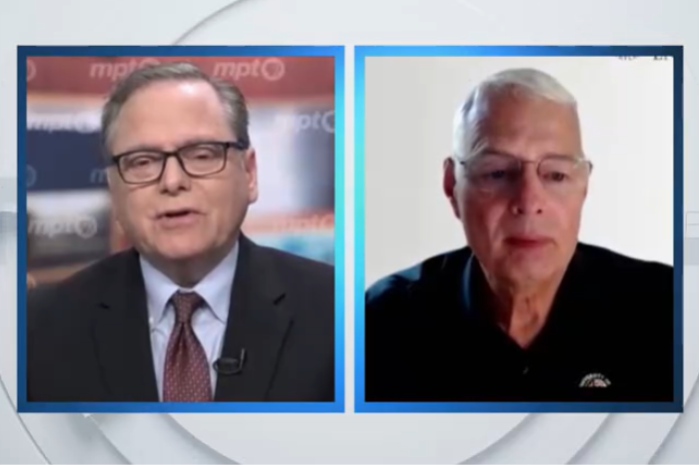
Maryland Public Television Highlights UMD Research on...
Stories / April 19, 2024
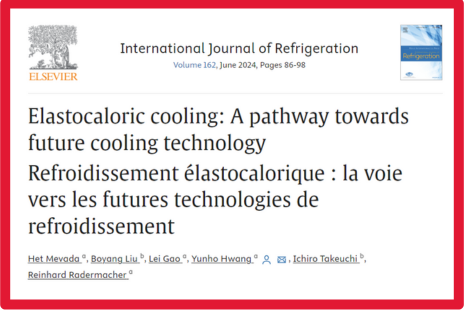
Could Eco-Friendly Elastocaloric Cooling Be the Future of...
Stories / September 4, 2025
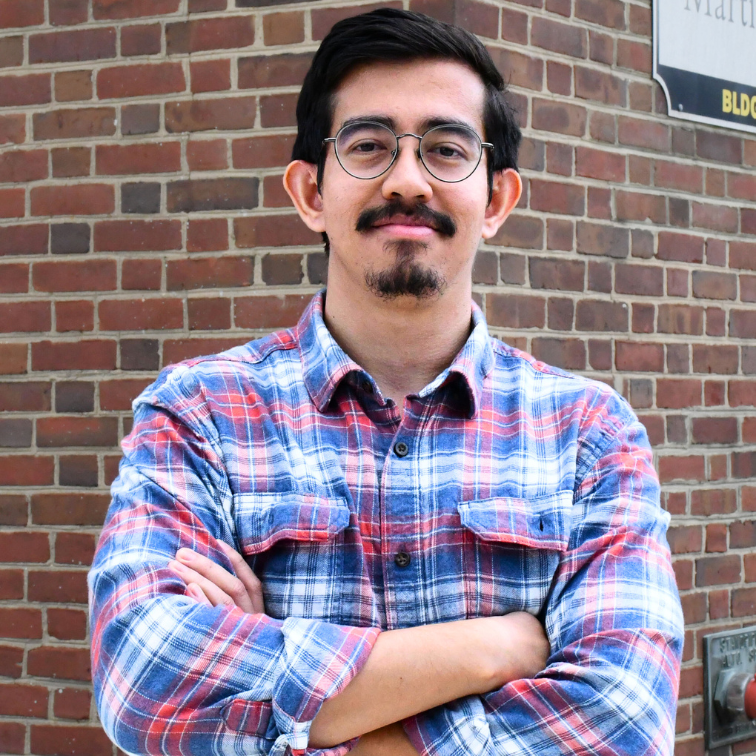
CEEE Welcomes Postdoctoral Researcher Arunjoy Baruah
Stories / May 21, 2025
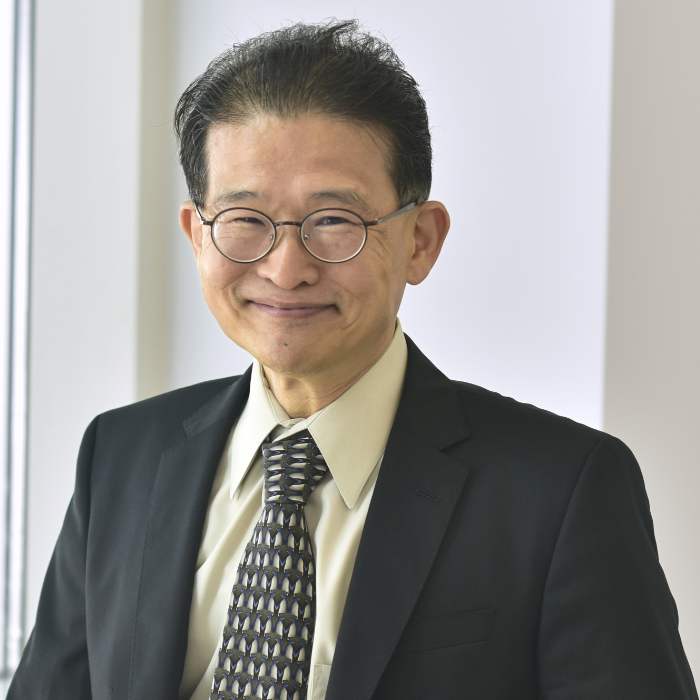
CEEE Research Professor Yunho Hwang to Receive Provost’s...
Stories / May 15, 2025
Join Us for a Tour of UMD's Energy Engineering Labs
Stories / September 9, 2024
New NSF Research Center Taps Into CEEE’s Expertise on...
Stories / August 11, 2024
Elastocaloric Cooling Named One of the Top 10 Emerging...