News Story
Dissertation Introduces Advanced Modeling Methods to Improve Heat Exchanger Design

Congratulations to Suraj Krishnamurti on defending his Ph.D. dissertation, “Finite Volume Modeling of Dehumidification and Frosting Phenomena in Compact Heat Exchangers With Generalized Flows.” Krishnamurti, a graduate research assistant with the Center for Environmental Energy Engineering (CEEE), will receive his doctoral degree in mechanical engineering.
Krishnamurti’s research focused on modeling and optimization of heat exchangers — critical components of HVAC systems — to improve efficiency and accelerate product development.
For his dissertation, Krishnamurti developed a novel finite control volume modeling approach for performance prediction of plate-fin-type heat exchangers. This approach can handle multiple fluids flowing in any arbitrary direction, reducing computational time while improving model robustness. He also developed advanced modeling approaches that take into account moisture condensation and frost formation in heat exchangers. “These models are designed to be faster and more robust than the state of the art, reducing engineering time,” he notes in his dissertation.
Krishnamurti conducted his research through CEEE’s Modeling and Optimization Consortium (MOC), under the guidance of CEEE and MOC Director Vikrant C. Aute, a research professor in the Department of Mechanical Engineering. Next, Krishnamurti will join Johnson Controls in York, Pennsylvania, as a modeling and simulation engineer.
“My time at CEEE has given me the chance to work on exciting and impactful research in an incredibly supportive environment with wonderful colleagues,” Krishnamurti says. “One of the highlights was attending CEEE’s semiannual Consortium Meetings, where I presented my research to CEEE’s industry sponsors. This gave me a unique opportunity to connect with industry partners and provided valuable insights that strengthened my research.”
A searchable listing of CEEE theses and dissertations published 2003–2026 is available online.
Published July 24, 2026
Related Stories
Stories / May 20, 2024
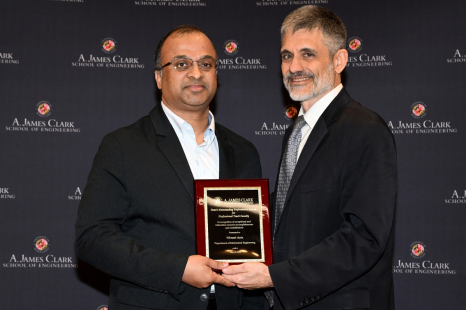
CEEE Co-Director Vikrant Aute Honored With Faculty Award
Stories / August 24, 2026
UMD Hosts Teachers for a Summer of Sustainable Cooling Research

Stories / August 19, 2026
UMD Develops ML Tool to Predict Uneven Airflow in AC Systems

Stories / May 28, 2026
New Framework Could Speed Up Thermal Storage Design and Reduce...

Stories / April 8, 2026
CEEE Provides Comprehensive Review of Plate-Fin Heat Exchangers

Stories / November 7, 2025
CEEE Welcomes Assistant Research Scientist Sunil Kumar
Stories / September 15, 2025
UMD Team Develops One of the Most Compact Heat Exchangers for...
Stories / August 11, 2025
UMD Provides "Cool" Research Experience for Two School Teachers
Stories / August 6, 2025
UMD Team Develops Design Optimization Framework for Ultra-High...
Stories / July 15, 2025
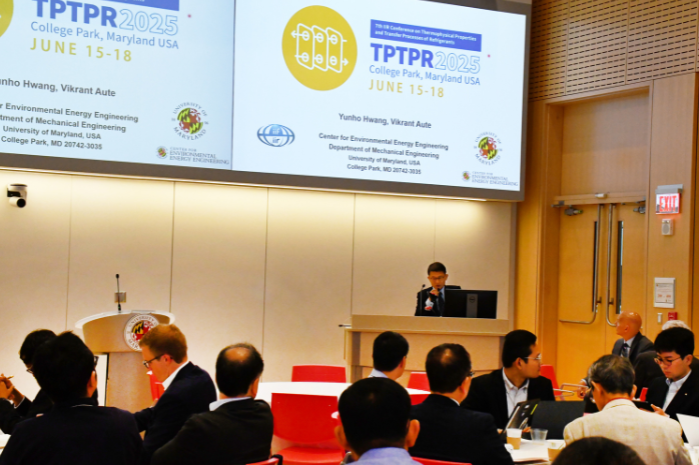
TPTPR Conference Showcased Cutting-Edge Research on...